
How much worse can classical music criticism get in the
Los Angeles Times? In particular, I'm referring to the increasingly poor quality of what the organization's lead classical music critic, Mark Swed, has been producing. It has gotten to the point that one wonders if our region's largest news organization isn't asking itself if this is the best coverage it can provide of one of the key components of L.A.'s cultural life. This year Swed has managed to attack the use of most online social networking for classical music as
“technological fascism” and to blithely use the
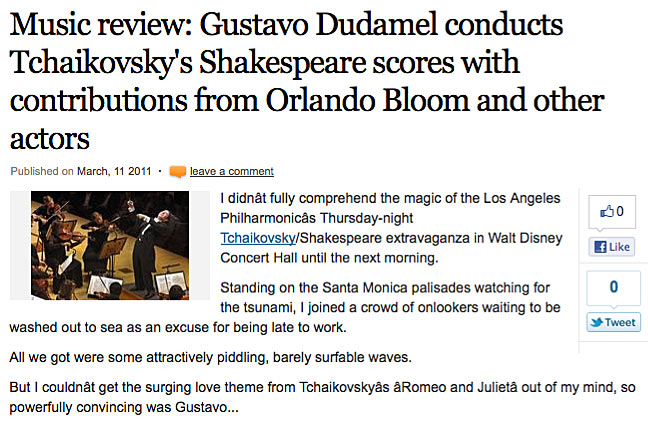
Japanese tsunami in March as a framing device to describe the powers of Gustavo Dudamel (which he and his publisher later retracted, although the copy lives on in news aggregation sites and
screen captures). He continues to offer Los Angeles readers little besides blind boosterism for their local orchestra. And now he’s rekindled one of his other favorite pastimes - picking fights with young East Coast composers.
This all started with
Swed’s positive review of Los Angeles’ young and adventurous chamber orchestra wildUp on Saturday. (Or you can read my
more detailed account of the show if you'd like.) Of course this presented an occasion for him to take an unnecessary swipe at young East Coast composers for some unexplained reason:
Uniting pop with new music is not new. Everyone does it. In happening arts centers such as Brooklyn, virtuous young musicians insist that Minimalism and anything that iTunes happens to be promoting that week must get along. Wired urbanites making nice is always nice. But soupy Radiohead arrangements are another matter.
(Note the obligatory Radiohead reference to establish street cred. But I digress.) I assume this intro, which has almost nothing to do with the rest of the review that follows, had its intended effect – pissing off New York-based critics and musicians alike. All kinds of drama broke loose on Twitter when
The New Yorker music critic Alex Ross kicked things off with this:

Which soon led to a flurry of responses from many corners including composers Judd Greenstein, Nico Muhly, and critics like Daniel Stephen Johnson and Alan Kozin to name a few. Some of the best of these 140 character tidbits are as follows:


Now I’m not saying that there is anything wrong with Mr. Swed expressing unpopular opinions or opinions that I or anyone else do or don’t agree with. But I am unclear how this particular statement, in this particular piece provides any added benefit to anyone. Is it telling us more about the wildUp performance or how it fits into the greater scheme of things? Does it provide real insight into the local or national music scene? It certainly does a disservice both to the New York based artists he alludes to as well as the West Coast-based artists he is writing about in the article. At best, this Tupac/Biggie Smalls approach to arts writing is lazy journalism. Swed’s writing is increasingly cranky and out-of-touch with what's going on in the music world and what is unfamiliar within his frame of reference is often met with off-hand derision. When it comes right down to it, Los Angeles, the
Times, and the local music scene deserve much better writing and much better criticism than what Swed is providing at this point.
Post-script: Although this post is not about me, I think I should say one more thing. I’m not arguing here that I am free of any of the vices I’ve mentioned here with regards to Mr. Swed. Nor is Out West Arts meant as a substitute for music writing in the
Los Angeles Times. I am certainly unfair at times and have plenty of weaknesses as a writer and sometimes amateur critic. However, I am also not paid to write music criticism and OWA is not a comparable platform to the region's largest news organization. We all should expect more of Mark Swed and certainly more of the
Los Angeles Times.
Labels: Los Angeles Times

It’s hard to believe the Los Angeles Times employs a music critic as out-of-touch with contemporary culture as Mark Swed, but they do. He’s gone
on the record in the past about his disdain for technology, and this weekend
his latest salvo in some imaginary war between technology and classical music went up. He talks about what he calls “technological fascism” or the blind faith in services such as Twitter, Spotify, and the social media consultants who advocate the use of online technology by performing arts organizations to increase attendance. And as borderline offensive as appropriating the term “fascism” is to refer to something he objects to about marketing and the arts, his broader point is utter nonsense.
Swed begins by making sure we know he’s a down guy. He’s up on the latest trends and dissolving boundaries between contemporary classical and popular music styles he tells us. He does the kind of routine name-dropping of artists like Bjork and Radiohead that classical music critics always do when they want to ensure that readers understand this fact about them. But what's really got his panties in a bunch is an unreferenced story about a orchestral concert where audience members were encouraged to tweet during the performance if they wanted. Specifically, that this was encouraged by some nefarious unnamed social marketing consultant as an idea to bring in more youthful faces in the hopes of making them regular ticket buyers. Heaven forbid.
His complaint is that tweeting, and much online activity, distracts from actually paying attention to and experiencing live music not to mention the irritation it can cause performers. Fair enough. I’m certainly no advocate of engaging in tweeting or any other online activity during the course of a live performance and find it as irritating as the next guy. But Swed’s extrapolation that the mindless encouragement of such activity poses a threat to classical music or culture on the whole is ludicrous. The point he’s making is that tweeting and use of other services like iTunes and Spotify are perceived by some as unquestionably positive. Furthermore, these technologies have been developed on a pop music model with little benefit and some potential downside for lovers of classical music. The use of these services is then advocated by social marketing consultants to classical performance organizations in thoughtless and poorly developed ways in an effort to increase ticket sales and attendance. But we're told that the threat is much bigger than just some inept marketing strategies. We’re told by Swed that, “This has nothing to do with technophobia but with big and serious issues, and ones that go beyond classical music.” You see this marks the decay of culture and our inability to “disconnect” and experience things without a technological interface.
But I find it hard to believe that all of this is really such a threat to art or culture. First of all, rampant availability of tweeting or online friendly concerts is hardly going to bring in throngs of new faces to anything they aren’t actually interested in to begin with. I doubt there are hordes of 25 year-olds who would love to pay 100 dollars or upward for an orchestra concert now that they now they can use their smartphone during it. And who is to say how one has to behave to get something personally meaningful out of an experience anyway. My focus has waxed and waned at times even in some of the greatest shows I've ever seen. Rapt attention isn't everything. One does want to be respectful of one's neighbors certainly, but there is more than one way to listen to music despite what Mr. Swed would have you believe. As for the issue Swed raises about small recording labels being threatened by Spotify, there is no evidence that this service, or iTunes for that matter, has driven down sales of classical music overall. Though Swed cites
Brian Brandt of Mode Records' piece about the devastating effects of Spotify on his label in the last six months, one can simultaneously see
Naxos reporting substantial increases of 6% in sales of recordings during this same time period despite their catalog being available on Spotify for over two years. Now I recognize that comparing Mode and Naxos is unfair on many levels, but I think the overall point is still valid. Maybe it's not the technology, but one's ability to use it as a tool to one's benefit that's the issue. Spotify has been available in Europe for years and yet the availability of classical recordings there remains the envy of anyone in the U.S who is paying attention. In fact, Spotify may have the exact opposite effect when it comes to classical music. Having a cheap streaming version of some recordings to sample may actually increase people’s interest in purchasing recorded music, not decrease it.
So while Swed has set up his straw man of rampant smartphone use during classical concerts and invented the bogeyman of internet technology decimating creativity, he ignores the most simple and logical facts. Live classical music performance and peoples’ interest in it has survived the steam engine, the gramophone, electric light, the automobile, movies, television, CDs and Lindsay Lohan. I hardly think that iTunes, Spotify, Twitter or the internet for that matter is going to suddenly finish that off now whether that is big label stars like Lang Lang or emerging independents. Inept marketing has always been with us and will always be so. Art and artists have thrived in much more economically hostile conditions historically than they do now. Art and music will go on. Audiences are smart enough to decide for themselves what they want to hear and in what manner they will pay attention to it in order for it to mean something to them regardless of the technology they have at hand and regardless of outdated proscriptions from classical music critics.
Labels: Los Angeles Times

This week, the
Los Angeles Times’ “Culture Monster” “blog” waded into commentary about Twitter by
naming 25 folks interested readers might want to follow in various areas of the fine arts - Art, Architecture, Classical Music, Theater, Dance, and Jazz. The list reads something like the nominees for the Grammy Awards, a few contenders with legitimate merit mixed in with name checking acknowledgement of popular best sellers and familiar faces. Of course, the LAT has not been known for its savoir-faire in the realm of social media. But rather than parse the dos and don’ts of this particular list of Twitter picks, what caught my eye most was the list of contributors to the selections at the bottom of the article.
-- Marcia Adair, with David Ng, Charles McNulty, Christopher Knight, Christopher Hawthorne and Chris Barton.
Notice anything? That’s right. The LAT solicited input from all of its major critics in the various mentioned fields except for its primary classical music critic, Mark Swed. Why that’s the case is unknown to me. But I might guess that it could do with the fact that Swed has expressed a disdain for social media and on-line communication generally. He stated as much
in person during a 2010 panel discussion that he and I sat on in 2010, so the notion that he might actually not know who is worth following on Twitter when it comes to classical music would fit in with such a world view.
Which raises the question, is having that kind of knowledge important? If your work is writing about music or art in a public forum, is it part of your duty to stay up on what’s going on, on-line? Certainly I think everyone would agree that staying up on developments in your area of expertise, like music, is a necessity. And one might also argue that being up to speed on what colleagues are writing about might be part of that job as well. But what about what is going on in social media? Certainly many of the artists involved in producing the work under discussion are participating actively in arenas like Twitter and Facebook. And while not every word of it is newsworthy or worthwhile, some of it is. And avid followers of the arts, many of whom are the primary consumers of a critic's work, are certainly following all of this information right alongside what is being written in the inches allotted for criticism in the LAT. I guess my feeling is that in 2011, writing about music and art also means keeping up with some awareness of what is being said in the virtual world as well. And in the meantime, go out there, and follow whoever you want. If you want some additional Twitter pics for classical music I'd start with @JoyceDiDonato, @amandaameer, and @nightafternight. As for me, I’ll be here and maybe on Google+ as well.
Labels: Los Angeles Times, Twitter



 Now I’m not saying that there is anything wrong with Mr. Swed expressing unpopular opinions or opinions that I or anyone else do or don’t agree with. But I am unclear how this particular statement, in this particular piece provides any added benefit to anyone. Is it telling us more about the wildUp performance or how it fits into the greater scheme of things? Does it provide real insight into the local or national music scene? It certainly does a disservice both to the New York based artists he alludes to as well as the West Coast-based artists he is writing about in the article. At best, this Tupac/Biggie Smalls approach to arts writing is lazy journalism. Swed’s writing is increasingly cranky and out-of-touch with what's going on in the music world and what is unfamiliar within his frame of reference is often met with off-hand derision. When it comes right down to it, Los Angeles, the Times, and the local music scene deserve much better writing and much better criticism than what Swed is providing at this point.



Follow Along
Brian
Los Angeles
Follow me on Twitter