Opera, music, theater, and art in Los Angeles and beyond
After Alice
June 18, 2012
l-r: David Trudgen, Ashley Emerson, and Aubrey Allicock Photo: Ken Howard/OTSL 2012In 2007, James Robinson, the current Artistic Director of Opera Theater of Saint Louis, had the good fortune to see the world premiere of Unsuk Chin’s opera Alice in Wonderland while on a visit to Munich. According to his own report, he was mightily impressed and became convinced it was one of the most important operas written in the first decade of this Century. I was there too, and shared his convictions about this daunting, beautiful opera, which had been slated to premiere in Los Amgeles, but was later redirected with then music director Kent Nagano’s departure from L.A. to Munich. Fortunately, Robinson was soon in a position to get Alice to the U.S. and after asking Chin to adapt the opera for markedly smaller forces than those called for in the German premiere, the Saint Louis debut was set.
I was thrilled when I first hear about this, though admittedly before seeing Sunday’s performance, I had grown wary of the potential outcome. The world premiere of the opera had been staged by German artist Achim Freyer and was filled with his trademark visual tricks, masks, and perilously raked stage. It was a perfect fit for Chin and her librettist David Henry Hwang’s take on the story which focuses exclusively on the dream material of Lewis Carroll’s story eschewing Alice's life outside of Wonderland entirely. Freyer’s vision, which reportedly was not well-liked by Chin herself, was as vivid and visually powerful as a dream and looked nothing like you’d expect from a century’s worth of Alice adaptations. Freyer used the story as a springboard to talk about the lost innocence of youth which evaporates not unlike the most fantastic of dreams. In contrast, Robinson and his design team are't plumbing such great depths. Despite protestations to the contrary, Robinson and his collaborators have gone with a show that looks and feels very much like the Victoriana you’d pick out of dozens of films or printed versions of Carroll's story. Furthermore, the questionable marketing of the show focused on the performances as being something that the whole family might enjoy. Which I suppose could be true if you’ve got the kind of 12 year-olds who go to summer camp at IRCAM.
But, I’ll admit I was pleasantly surprised at first to hear and see this production of a musically adventurous and very smart opera. The set is filled with giant cupboards and dressers that are painted gray, but open to reveal any number of more fantastic rooms and interiors for characters to pop out of. All of the closed surfaces are used for elaborate filmed projections that indicate the most difficult events in the opera to stage such as Alice swimming in a pool of her own tears or her dramatic post-prandial size changes. The contrast between Chin’s amusing but very modern, dark score and a visually accessible and familiar staging was a brilliant contrast in the end. Robinson uses moments of pantomime and physical humor in clever ways to bring characters like the caterpillar to life as well. But this is a long show, with a fantastic and episodic plot and while Robinson leads the audience down the rabbit hole he doesn’t know what to do with them once he gets them there in this intermissionless two hours. The second half of the opera nearly unravels with bad decisions suggesting Robinson may have lost the strength of his convictions. The large crowd scenes toward the end of the show including the Knave's trial are far too big for the tiny cramped Loretto-Hilton Center stage. The cast is reduced to waving their hands about for acting and the dreamy flow of the show freezes up. Worse yet, signs of desperation set in and Robinson allows some characters including the dormouse and the Duchess to engage in mawkish pandering by serving up the kind of clichéd hip-hop inspired movements and delivery that produces applause and perfunctory laughter but kills the show by betraying trust in the source material’s ability to do its job without cheap stunts.
Chin’s reduction of the score continues OTSL’s recent string of successes of very listenable reduced versions of larger modern works including Corigliano’s The Ghosts of Versailles and Adams’ The Death of Klinghoffer. Michael Christie, the show’s conductor, continues here to build his reputation as one of America’s foremost advocates for contemporary operas. He easily maintains focus through turns in the score that go from sparse and economical to huge walls of black shimmering night. The whimsy is there too including the extended bass clarinet solo which serves as the voice of the caterpillar and Chin’s take of “Twinkle, Twinkle Little Star” for the Mad Hatter’s Tea Party. The huge cast is fronted by St. Louis favorite Ashley Emerson as Alice who is nimble and projects a necessary child-like pluck and sense of adventure. She handles both the sung and Sprechstimme passages convincingly. David Trudgen excels in the countertenor parts of the White Rabbit and March Hare. And that vanishing Cheshire Cat is never overlooked onstage as sung here by a winning, feline Tracy Dahl. When these performers are onstage in small groups with one another and the visual expanse of the dreamscape is given room to breath, the show is absolute magic. And that’s a big deal for an opera uninterested in presenting a logical narrative storyline, instead investing itself in the power of the illogical fantasized world of dreams. Chin’s Alice in Wonderland continues in Saint Louis through the end of next week and it’s a solid production worth seeing, especially for your hard-to-please Boulez-obsessed pre-adolescents.
Rod Gilfry as Sweeney Todd Photo: Ken Howard/OTSL 2012Sometimes, a new performance of a familiar piece of musical theater can be great for showing you something that you didn’t recognize before. But then again, there may be some things in this life that one really doesn’t need to know. Opera Theater Saint Louis is in the midst of their 37th season, and among the English-language Mozart and Carmen performances is Stephen Sondheim and Hugh Wheeler’s Sweeney Todd. The new production of Christopher Bond’s adaptation was directed by Ron Daniels and has a cast with Broadway star Karen Ziemba as Mrs. Lovett and Rod Gilfry as Sweeney Todd. The trend in staging this show in recent years has tended toward the lean, and very, very mean. Whether it’s Tim Burton’s movie or John Doyle’s bare bones mental ward, the show has gone creepy as can be. But not so for Saint Louis, where Daniels has cleaned up the streets of Victorian London a bit and gone for the big laughs. There’s nothing much changed with the text, of course, but while Daniels delivers something outside of the current practice, I’ll admit I’m not sure that the world needs a Saturday matinee type of chuckle-fest when it comes to the demon barber of Fleet Street.
Of course, it takes two to, well…, you know. And the audience I saw the show with on a self-same Saturday afternoon sounded ready for a good old fashioned musical and they weren’t about to have it any other way. I’d never noticed so many laugh lines in the opening number before, but there they were. In fact it wasn’t until Rod Gilfry got to the word “shit” (in reference to London and the world generally) that it seemed to occur to some viewers that this wasn’t The King and I. Even Sweeney’s eventual murders got big guffaws each and every time in Act II as the design team elected to go with forcefully spewing fake blood from the necks of his victims covering a good portion of the stage. The production is sparse, dominated by a back wall with an oven in it that is sometimes covered with a plastic blood-stained curtain. Even Sweeney’s infamous barber’s chair doesn’t quite function as it typically does with each body being pulled from the chair's farthest back reclined position by two costumed extras after each murder as the body is whisked offstage.
Karen Ziemba Photo: Ken Howard/OTSL 2012But there are strengths here, particularly in the cast. At the top of the bill is Gilfry who can sound as warm and beautiful as he has at any time in his career. He glowers with the best of them, but the overall tone of the production sometimes works against him. (I’ll admit that it’s also somewhat strange that this particularly tall and devilishly handsome Sweeney is still so difficult for the denizens of his old neighborhood to recognize.) Ziemba, on the other hand, is lock-step in line with the show with a bubbly, attractive Mrs. Lovett who comes off as more whacky and bemused than predatory. She delivers a fantastic version of A Little Priest, however, and vocally was always up to Sondheim’s tricky, precision-demanding lyrics.
There were both veterans and new faces in the supporting roles. I was particularly thrilled about a young man named Nathaniel Hackmann who was a magnetic, sweet voiced Anthony Hope. He may be among the best I’ve seen anywhere in the role and came off sincerely earnest and in love. More of him, please. Deanna Breiwick was a clear, bright-voiced Johanna who stayed clear of some of the simpering and camp aspects of that thorny role. And Kyle Erdős Knapp, as the doomed young Tobias Ragg, gave an unnerving wiry performance of perhaps the darkest of all the show’s roles. Of the three, Erdős Knapp is a current Gerdine Young Artist. It speaks well of the company that they’ve amassed three such compelling performances in this staging.
The members of the Saint Louis Symphony that play in the festival orchestra continue to be one of the company’s biggest assets. Here they were conducted by OTSL music director Stephen Lord who could let things go a bit sluggish here and there, but the stage-pit coordination in this challenging score were always on target. And he did the most important thing in letting Sondheim’s most brilliant songs speak for themselves plainly and directly. You could do worse than this Sweeney Todd and if you don’t mind all the yucks in the middle of your Victorian bloodbath, it may be the show for you. It's onstage now through the 24th.
Ashley Emerson and the boys of the chorus Photo: Ken Howard/OTSL 2011
The festival season for Opera Theater of Saint Louis was rounded out by performances of Don Giovanni and Donizetti’s La Fille du Régiment, both operas I’m predisposed to like. OTSL is a company deeply involved in the development of young American vocal talent. It’s the kind of thing New York City Opera used to do before…well, you know. Both of these productions featured some of the most notable young American singers who demonstrated both the promise and pitfalls of performers at this point of their careers. Mozart’s Don Giovanni is filled with the kind of bread and butter roles most vocalists are encouraged to master not just for matters of technique, but to afford them plenty of opportunities for singing engagements. It’s also worth noting that it is precisely this kind of youthful performer Mozart had on hand for the premiere of the opera in Prague in 1787. What we know of the vocalists who created these roles indicates that most were in their early 20s at the time of the first performance, so the Saint Louis cast may have more in common with what Mozart heard when he conducted the work than what one might believe.
Of course, having a youthful Don Giovanni as capable and dashing as Elliot Madore certainly makes this story of a lothario and the women who just can’t refuse him certainly more plausible. Madore was a winner of the 2010 Metropolitan Opera National Council Auditions, and Don Giovanni is an ideal role for him. He managed the vocal chores well and has ample stage presence and charm. He’s easy to fall for and not overly brooding as well. There were a number of other standouts in the cast, including Kathryn Leemhuis who sang a clear and sweet Zerlina along side Bradley Smoak’s not entirely hapless Masetto. Sadly the staging under the direction of Michael Shell and James Robinson was probably the weakest of the offerings this season in Saint Louis. Nearly half of the show was delivered in front of a dark blue curtain emblazoned with a reproduction of Mozart’s signature. The curtain was just a bit better than the flat painted backdrop behind it but no amount of pluck on the part of the cast was going to give this dramatic interest. There was a frequent over-reliance of the kind of groping and hip thrusts that provoke easy laughs and a pointless money toss was thrown in to the finale, which provided little more than a nice photo opportunity. The conductor, Jane Glover, kept the pace slow and plodding throughout, not doing anyone any favors. But I’d certainly pay to see Madore again, hopefully in something a little more developed overall.
Elliot Madore throws his money around Photo: Ken Howard/OTSL 2011
Donizetti’s La Fille du Régiment was much more cohesive in its presentation. A charming, simple storybook set complemented Seán Curran’s highly choreographed stage action. The show had a number of strategic cuts, which kept the focus on a rather sweet take on the story overall. The leads here included Ashley Emerson as Marie and another Met Opera National Council Auditions winner from 2008, René Barbera as Tonio. Both had strong turns in showy and vocally challenging roles. Emerson, who was recently seen in Los Angeles as Flora in Britten’s Turn of the Screw, was a physically comic Marie. She managed the vocal lines well with a clear line if she did turn a bit shrill on the highest notes. I found her a bit cold at first, but she seemed to warm over the course of the evening, which worked in the role overall. She made herself the heart and soul of this production and the audience was clearly taken with her. Barbera has a lovely tenor and he managed the high Cs in Ah mes amis well. He only sounded forced at the very end. His phrasing was a bit more problematic in the Act II aria "Pour me rapprocher de Marie," and I wish he’d paid a bit more attention to the conductor so that everything was in sync while he was performing. Luckily, Barbera was paired with John McDaniel in the pit who was overly deferential, altering the pace to suit the tenor’s wishes on the fly. McDaniel is a Saint Louis native and has worked extensively on Broadway as well as a stint as music director on The Rosie O’Donnell Show in the late 1990s. But he was a good choice here, given his ear for comic timing.
The highlight of the show, though, was a scene stealing Sylvia McNair whose Duchess of Crackenthorp was expanded a bit and tweaked to be an ex-opera singer. She sang a comic number, Flanders and Swann’s “A Word on My Ear,” which features the refrain “I’m tone deaf” and provided some hysterical moments of her intentionally off-key hijinks. The greatly appreciative crowd gave her the biggest laughs and the biggest ovation of the evening in what became the comic highpoint of a very cute show. Which just goes to show what talent can become when paired with experience. Here’s hoping all of these young vocalists can get to a point in their career where they can enjoy moments like McNair did this year.
l-r: Laura Wilde, Brian Mulligan, Nancy Maultsby, and Paul La Rosa Photo: Ken Howard/OTSL 2011
Unquestionably, the highlight of this year’s opera festival in Saint Louis has been the return of John Adams’ The Death of Klinghoffer to the American stage. Twenty years after its premiere in Belgium, followed by controversial runs in both New York and San Francisco, it received its first complete staging in the U.S. this month. It turned out that an opera in 1991 on the subject of the 1985 murder of Leon Klinghoffer by Palestinian terrorists aboard the hijacked Italian cruise ship the Achille Lauro was a topic too hot to handle at the time, generating denouncements from many quarters that it was biased in many different directions simultaneously. Which may be true, but, of course, it’s art and by its very nature and design, it’s meant to be unfair. The charges and protests provided an extra obstacle to the many that new operas already face in receiving second or third stagings, and so Adams’ second opera vanished from sight. It wasn’t even presented by some of the organizations that paid for its creation, including the Glyndebourne Festival and Los Angeles Opera. Why The Death of Klinghoffer has generated relatively little controversy during its resurfacing here is Saint Louis is the more interesting question. There have been no reports of protestors outside of the theater that I have seen, and outside of some pro forma media coverage on the history of the controversy, this production has come and gone with little more than its deserved laurels for artistic excellence.
The chorus in The Death of Klinghoffer Photo: Ken Howard/OTSL 2011
How this came to pass is likely manifold. Opera Theater of Saint Louis spent a great deal of time and effort preparing the community for the production, offering forums for members of the “Interfaith Community” to meet in public and share ideas and feelings on the issues at hand. The lack of controversy this time around may also have stemmed from a gradual reintroduction of the work to the public over the last few years through a number of concert presentations of the opera in part or whole around the U.S. and the rest of the world. Or it may be that we Americans have changed. The understanding and awareness of terrorism and its perpetrators is very different for the vast majority of Americans since 1991. That nagging question of how and why a group of people in the world hate so much, and specifically hate us so much, that they are willing to sacrifice everything to express that hate has far deeper resonance in the U.S. in 2011 than in 1991. The larger implications of a murder taking place half-way around the world now seems more personal than just another episode in an ongoing Arab-Israeli conflict. Terrorism may not have changed in 20 years, but our view of the world has and I would argue that The Death of Klinghoffer has as much to say about those questions and feelings now as it did then.
Christopher Magiera and Aubrey Allicock Photo: Ken Howard/OTSL 2011
But this is still an opera above all else despite its underlying meaning. Musically, it’s absolutely stunning. Although it was composed just a few years after Nixon in China the changes in Adams’ compositional style away from his more minimalist roots are already on full display. The Death of Klinghoffer is much more clearly related to later works, like Adams’ oratorio El Niño than his earlier compositions. It is often lyrical and outright pretty. The musical backbone of the opera is a series of large choruses that were wonderfully performed by the OTSL chorus with the orchestra under Michael Christie. The choruses do not move the narrative of the hijacking forward, but serve as a point of reflection on the history, emotions, and underlying conflicts that fuel the opera’s actions. These are themes and text that would be difficult to ascribe to particular characters and they provide an overwhelming counterpoint to the other activity on stage. The action of the opera mostly takes place off stage with characters instead describing their histories and internal emotional states in Alice Goodman’s wonderful libretto. The work’s crescendo arrives with a pair of arias sung by Leon Klinghoffer and his wife Marilyn after his death. Brian Mulligan, a vocalist whom I admire more and more with each listening, gave another piercing performance in what Adams calls the “Aria of the Falling Body” where Klinghoffer reflects on his life as his dead body falls to the sea in his wheelchair after it has been pushed off of the boat. Nancy Maultsby’s Marilyn gets the final word of the evening with a brilliant aria of pain and rage directed toward the ship’s captain that both parallels and references the arias given to the terrorists earlier in the opera.
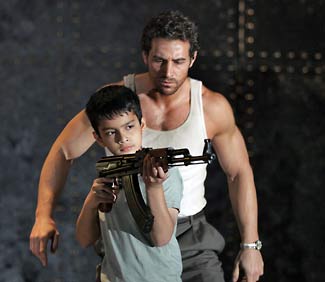
By request: One more photo from the gun show. Paul La Rosa as "Rambo" Photo: Ken Howard/OTSL 2011
All of the cast members give credible and very engaging performances including Christopher Magiera as the captain, Aubrey Allicock as Mamoud, and Laura Wilde as the young Omar. The excellent Lucy Schaufer plays a trio of international passengers aboard the vessel who seem more or less oblivious to the seriousness of what is unfolding around them. The festival’s artistic director James Robinson, who also directed this production, creates a simple set dominated by a multi-panel wall resembling the hull of a ship. There is ample video augmentation on a movable banner-shaped projection screen that is raised and lowered. There is a minimal amount of fuss over the actions of the chorus which do include some activity directly referencing the Arab-Israeli conflict, but not so much that it becomes cloying or heavy handed. Robinson lets the characters speak for themselves.
It’s doubtful that The Death of Klinghoffer is going to change anyone’s mind about anything. It is not going to make people into terrorist sympathizers nor is it going to rally Americans for increased military action overseas. But it does reflect on a world we live in right now quite beautifully and encapsulates some of the emotions streaming from that time in ways that are both frightening and touching. Audiences in Saint Louis have been lucky enough to see this work again and hopefully it will live again elsewhere very soon.
Corinne Winters, Liam Bonner, Gregoy Dahl Photo: Ken Howard/OTSL 2011
The 2011 Opera Theater of Saint Louis festival season concludes this weekend, and I’ve traveled back to my old stomping grounds to catch up with what has turned out to be a very high profile and successful spring and summer for the company. OTSL is blessed with a number of benefits including the very intimate theater at the Loretto-Hilton Center and one of the nation’s great orchestras, the Saint Louis Symphony Orchestra, as the house band. Both of these features paid off enormously with this season's production of Debussy’s Pelléas et Mélisande, the company's first, in a staging under the direction of David Alden. This is one of the most beautiful operas in the standard repertory and also one of the most fragile. Debussy’s bold response to the monolithic work of Wagner did as much to set the tone for 20th-century music as Schoenberg, Stravinsky, or the “Tristan chord.” Pelléas just did it more quietly. Any production of this opera requires a fine orchestra and the players of the Saint Louis Symphony Orchestra under the direction of Stephen Lord brought the subtle coloring of Debussy’s score to life beautifully. They were joined by a solid and involving young cast. Liam Bonner was Pelléas. He’s got a sizable baritone that’s warm and brighter on the top and he handled the “childlike” qualities of the young lover well. I greatly look forward to his appearances in Los Angeles next year as Sid in Britten’s Albert Herring. Bonner was cast opposite soprano Corinne Winters who made one of the more enigmatic opera characters, Mélisande, sympathetic and engaging. Gregory Dahl sang Golaud with a fair amount of menace. I was again very impressed with the young Michael Kepler Meo, an OTSL veteran who returned as Yniold. He managed Alden’s direction, including a mad scene, and the vocal work with remarkable assuredness and real musicality much as he had in his appearances in Britten’s Turn of the Screw in Los Angeles earlier this year.
Corinne Winters and Liam Bonner Photo: Ken Howard/OTSL 2011
If there was a downside for me to the evening it was some of David Alden’s direction. The set was one of Alden’s preferred highly patterned rooms with large movable curved walls that create spaces more imagined than naturalistic. The action is moved to the time of the work’s composition, although there are still several Medieval references to Maeterlinck’s original text. All of this was sharp and eye-catching. There were several striking ephemeral images as well such as when Yniold appears as the two lovers visit the cave in Act II. He is carrying a mirrored ball and the projected lighting from it fills the theater, producing a similar reaction from the audience as the moonlight entering the cave does for Mélisande.
But for all the impressionistic imagery, Alden also strives for a clarity of emotional interaction between the characters. Golaud is much more angry and hostile throughout the entire performance. Scenes that are often left somewhat ambiguous in the hands of others, like when Golaud takes Pelléas into the vaults of the castle, are played as straight-forward thriller more than abstract suggestions of psychological conflicts. The love triangle in the libretto is clarified and dramatized to the point that the proceedings lose some of their mysterious beauty in favor of action akin to Sleeping With the Enemy. But the need for definition in the dramatic action doesn’t manage to overwhelm the show as a whole, and Debussy’s beautiful impressionistic masterpiece received a loving and much appreciated welcome to Saint Louis.
James Westman as Beaumarchais and Maria Kanyova as Marie Antoinette Photo: Ken Howard/OTSL 2009
Remember what I was saying about Opera Theater of Saint Louis being at the forefront of American Opera? Well my second night in Saint Louis gave more supporting evidence for this contention with a new production of John Corigliano’s The Ghosts of Versailles with a libretto by William Hoffman. It’s a huge, beguiling, and ambitious opera and even in its smaller, leaner “new revised edition” a mammoth undertaking. Saint Louis, in conjunction with Vancouver Opera and the Wexford Festival, have an excellent and amazing spectacle on their hands and they should be commended for it. Corigliano and Hoffman have put together an opera so demanding in its resources that it seemed uncertain when the score would again see the light of day. After two successful runs at the Metropolitan Opera and one at the Lyric Opera of Chicago in the 90s, the work had gone into hibernation. The Met abandoned plans to revive it this season in light of the economy, and after my first exposure to it I can see why. Even here the show seems to swell the Browning Theater stage with so many people and so much activity that it’s hard not to watch it all with a sense of amazement. But here is Opera Theater of Saint Louis proving that you don't have to be big to move the art forward. Corigliano and Hoffman's work may in fact be better served in a scaled down more direct approach.
The story is truly a postmodern one. It employs the play-within-a-play format, but not as a matter of arch interpretation, rather one that is actually called for in the libretto. The setting is Marie Antoinette’s court theater at Versailles and prior to curtain, the scaffolding and tarps that surround the free standing proscenium and back stage of the court theater set are overrun by a modern day construction crew managing some ongoing renovations. As the orchestra tuning slides directly into the first notes of the score, they depart and are replaced by the ghosts of Marie Antoinette, Louis XVI, and members of their court. Marie, or as she is more familiarly referred to as Antonia, has spent two hundred years not getting over her assassination. The ghost of playwright Beaumarchais is also on hand, however, and is enlisted to cheer her up with a play that he hopes will also serve to reflect his love for Antonia and provide her with a rewrite of the history that vexes her so. The play he presents is a broadly adapted version of the real third play in Beaumarchais’ Figaro trilogy, La Mère Coupable. Enter some of opera’s most familiar faces, Figaro, Susannah, Count Almaviva, Rosina, Cherubino, and so on. Soon there are two parallel narratives that slowly merge into one. It’s complex, but never overly so. The point is whether or not Antonia can escape another decapitation at the hands of the revolution and how this plays out in the context of her relationship with the playwright.
Sean Panikkar as Almaviva and Christopher Feigum as Figaro Photo: Ken Howard/OTSL 2009
And The Ghosts of Versailes is also often very funny. Figaro is up to his usual scheming ways and there are some great bits including a scene where he poses as a belly dancer to thwart a couple of plots simultaneously. I can’t recall the last time I heard real laughter in an opera. And I mean more than a pleasant chuckle of acknowledgment, but outright guffaws. But there it was, and credit should be given to Christopher Feigum who plays this pivotal role. It’s not the biggest role, of course, and vocally he could be a bit more adroit, but it's still a winner. However, in the end this is really an opera about the relationship between Beaumarchais, played by James Westman, and Marie Antoinette, played here by Maria Kanyova. Kanyova in particular gave an excellent vocal performance and made it clear why Angela Gheoghiu had agreed to play the role in the now-abandoned Met revival. She has the best music in the show and a part with some real acting meat to it.
The staging, directed by James Robinson, is very, very smart, making a big deal out of rather modest elements. The tarps at the rear of the largely empty set are often filled with video projections to flesh out scenes and give them context. Granted, not a new idea, but one that works quite well here creating a real variety and mutability in the gray space. Color is used very effectively with the ghosts in gray plus one red accessory highlighting their manner of death and the Figaro characters in bright popping neon hues. It creates a sort of through-the-looking-glass feel to the evening, and I never found the activity on stage dull to look at.
Maria Kanyova as Marie Antoinette Photo: Ken Howard/OTSL 2009
If there are weaknesses in the opera, they stem mostly from the source material. The Ghosts of Versailles is intriguing and fun, but it may not be a great opera even by late 20th-century standards. The music can be dark and very modern at times in the ghost scenes, but the Figaro scenes are filled with an amalgam of styles and at times the big arias can sound like something right out of Andrew Lloyd Weber. Make of it what you will, but it doesn’t have a uniformity of style that would immediately recommend it as the product of a sole artisan's voice, though it may in fact be that. The libretto is far from rock solid either. Hoffman sets out with a great premise and can oscillate between comic and dramatic elements. The "inner" opera of the storyline provides for a number a expected cracks about the art form itself with ghosts proclaiming their boredom and crying out "this is not opera!" However, as the stories merge, logic begins to lose its grip, and the trial and subsequent jail scenes in Act II can drag and seem forced at times. But on balance this production's charms carry the day, and if you’re in Saint Louis and have even a passing interest in opera, you should see this production before it closes on the 27th of June. And thinks to Opera theater of Saint Louis for proving that American Opera lives on and it needn't be in the grandest of all settings to continue to exist.
l - r: Alek Shrader, Maureen McKay, Daniela Mack, and Paul Appleby Photo: Ken Howard/OTSL 2009
It’s muggy and stormy here in St. Louis this week. I forget that I live in a “dry heat” area now, and a trip back to my old stomping grounds has brought back all kinds of associations. One of the most positive of those is a return visit to the summer season of Opera Theater Saint Louis which is in the middle of a very strong series of shows through the end of this month. Entering its fourth decade, this regional opera company has quickly risen to the forefront, along with Santa Fe Opera, in providing first-rate productions featuring the best North American talents in both vocal and instrumental music, stagecraft, and composition. It’s a mantle that New York City Opera lost about two decades ago, and luckily for the rest of the country, the highest quality home grown opera is readily available in places outside of New York City.
Take as exhibit A, a new production of Mozart’s Il re pastore which I saw on Tuesday. Who needs international superstars when you have a largely American cast as good as this one? Heidi Stober plays Aminta with real wit and grace. I loved her as La Follie in the revival of Laurent Pelly’s production of Platéea few years back in Santa Fe, and she was just as exciting to watch here. Opposite her was Alek Shrader, a young tenor who is certainly on the rise after being featured this year in the heavily promoted documentary about the Metropolitan Opera’s 2007 National Council Auditions. His future seems certain on an opera stage given that he has a clear and well-controlled voice that is both strong and bright. And the fact that he’s totally hot doesn’t hurt either I suppose. The rest of the cast including Paul Appleby, Daniela Mack, and Maureen McKay all proved themselves as more than capable Mozart singers under the baton of Jean-Marie Zeitouni.
Heidi Stober as Aminta Photo: Ken Howard/OTSL 2009
It’s a testament to the cast that they were so watchable in a production that could be divisive among audiences. The production stems from the minds of Chas Rader-Shieber and David Zinn, two well-known and capable opera stagers who have long associations with numerous American houses including NYCO. It’s an update and a transposition in story that uses the old play-within-a-play device, not unlike Mary Zimmerman’s recent controversial La Sonnambula for the Metropolitan Opera. And while this is a much lower profile gambit here, the results can be somewhat similar. In fact this particular version of Il re pastore seems to almost directly refer to Jean Anouilh’s The Rehearsal, but without the Freudian overtones.
Alek Shrader as Alessandro Photo: Ken Howard/OTSL 2009
Il re pastore is a standard Baroque opera seria plot with two sets of lovers being inadvertantly separated and later reunited by a benevolent king. Aminta, a shepherd, is recognized by Alexander the Great and his adviser as the true king of Sidon whose illegitimate ruler his forces have just dispatched. While Aminta's unsuspecting elevation to the throne might be good news, it creates havoc between him and his love, Elisa, who wants to keep things simple. The action in this production is updated to the late 19th century in an upscale British drawing room where a young couple have just been engaged and their friends have come to celebrate. While there, they prepare a performance of Il re pastore with the young woman singing Aminta, her maid singing Elisa, and the woman’s fiancée performing the Alexander the Great role. Early on, it seems the the young woman singing Aminta is celebrating her engagement, but begins irritating her future groom when she begins to take the Mozart role she is in the midst of performing too seriously, directing her attention toward her maid in a mock bridal ceremony. Confused yet? The conceit works at first, but as things move along, the sense of it all breaks down as the characters become more involved in the opera story line than whatever the implied meta-narrative is. On some level, the staging wants to emphasize the themes of stepping outside of one’s class role apparent in Mozart’s opera. The maid abandons her servile position in the Victorian household as she becomes involved in the rehearsal only to be thrust back into it by the end of the show. But admittedly, despite the fact that the sets and costumes look great and I was very entertained throughout, it could get a bit frustrating to try to think through it all. But with a musical performance and singing this good it’s easy to overlook a lovely if misguided staging. Il re pastore runs through June 26.





Follow Along
Brian
Los Angeles
Follow me on Twitter