Opera, music, theater, and art in Los Angeles and beyond
Shadows and Fog
June 18, 2019
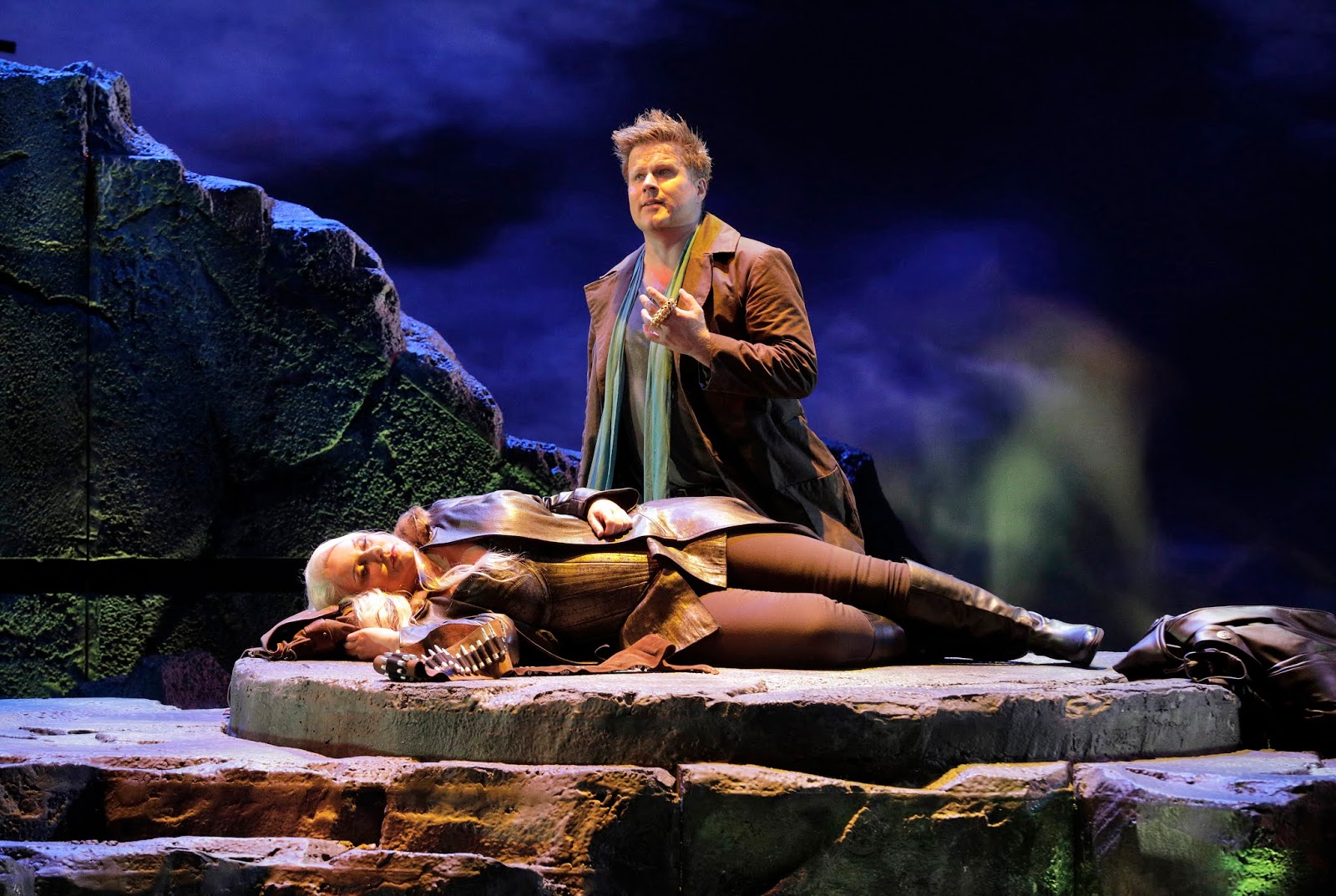
Rachel Willis-Sorensen and Brandon Jovanovich in Rusalka Photo: Cory Weaver 2019
It was grey, cold, and overcast in San Francisco last weekend; perhaps the perfect weather to complement San Francisco Opera’s premiere of Dvorak’s Rusalka on Sunday. Perfect in that the weather outside easily mimicked the dark, gloomy, latter-day Victoriana, which is the preferred stomping ground of David McVicar, the new production’s director. SFO imported the production from Lyric Opera Chicago for their second ever presentation of Rusalka following a company premiere with Reneé Fleming in the title role in 1995. This tale of a water nymph who makes a bargain with a witch to become human and pursue a man she loves has been steadily growing in operatic popularity over the last thirty years thanks in no small part to a number of advocates including Charles Mackerras and Fleming herself. McVicar’s take on the story emphasizes the role of the Prince who rejects Rusalka’s love and later regrets it greatly. In this version, Rusalka is a dream of sorts of the unhappily married Prince as laid out in a pantomime that opens the staging. It’s an interesting idea, but one that rings hollow given that the libretto focuses almost exclusively on Rusalka’s internal emotional state. There are also overtones of the degradation of the natural world that parallel the characters’ emotional degradation. The woodland glen of the opening act is encroached upon by industrial runoff structures as the evening moves on. All of this is very dark and murkily lit, resulting in a show that is attractive if not always newly insightful. And while McVicar’s gloom certainly resonates with certain themes of this very adult fairy-tale, the performance itself was unabashedly one of brightness and shiny luster.
SFO has gathered together a world caliber cast for the performance, including the role debut of American soprano, Rachel Willis-Sorensen. Her star has been on the rise in the US and Europe in recent seasons and this is a major success for her. Her bright, easy tone soars above Dvorak’s lush orchestral writing and she is perfectly heartbreaking in the conclusion to this work. She is reason enough to see this production and undoubtedly a super-star in waiting. Opposite her is Brandon Jovanovich, a SFO favorite, as the Prince. His muscular tenor is well-suited for a role which seems like it was written for him. There is real chemistry between the two performers, which does more to sell this story than any amount of stage fog does. The witch Jezibaba is voiced by Jamie Barton, who again proves to be the most-valuable player in just about every performance she steps into. Despite being saddled with perhaps the worst of the corseted Victorian garb of anyone in the cast, she rises above it all with a remarkable rendition. The orchestra, under the direction of conductor Eun Sun Kim, was appropriately light and warmly lyrical at every turn.
Sasha Cooke and Christian Van Horn in Orlando Photo: Cory Weaver 2019
Playing opposite Rusalka this summer in San Francisco is the company’s second ever performances of Handel’s Orlando. SFO has an exceptionally good track record of presenting Handel’s operas and there are many things to admire about this staging as well. The production places the action in a London hospital during the Blitz. Orlando has let the battlefront in search of his love Angelica who is accompanying her love, Medoro, injured during combat. All the action takes place in various rooms of the hospital and director, Harry Fehr, cleverly recasts the magical spells Zororastro uses on Orlando at different moments in the libretto as psychiatric treatment used to help a shell-shocked Orlando “recover” from his angry plans of vengeance for a spurned love. Boldly this includes a scene of Orlando undergoing electric-shock treatments in the final Act. It all works decidedly well in a smart looking production that keeps up the pace in a Baroque plot that can seem muddled at times. Fehr also deftly deployed video elements at critical points in the story to elucidate actions critical to the plot but perhaps difficult to see from the audience such as the gifting, and later loss, of Orlando’s ring.
The cast was again filled with many notable American vocal artists. Orlando was sung by Sasha Cooke, who was announced as sick at the beginning of the evening, but performed admirably despite this. Heidi Stober, Christina Gansch, and Christian Van Horn all gave committed performances as well. If there was a stand out in the cast, it was countertenor Aryeh Nussbaum Cohen, who sang Medoro. He was a replacement for the originally announced David Daniels, who was withdrawn from the production last year. Cohen was on fire on Saturday. Vocally agile, warm, and powerful, he dominated every moment he was on stage. Christopher Moulds made his company debut in the pit with a well-paced and detail-oriented performance.
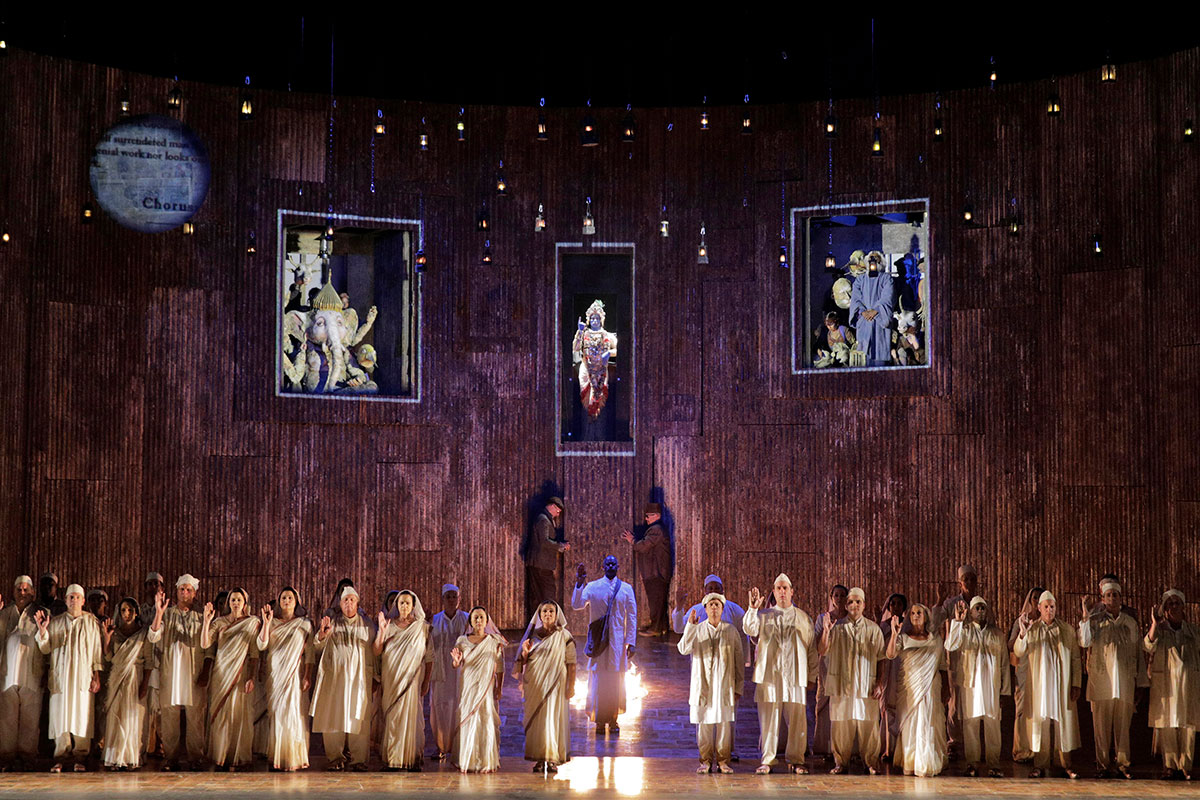
Sean Panikkar and cast of Satyagraha Photo: Cory Weaver 2018
The Los Angeles Opera’s presentation of Philip Glass’s Satyagraha now onstage through November 11 has a momentous feeling about it. Phelim McDermott and Julian Crouch’s 2007 landmark production of this previously ignored late 20th-Century masterpiece may have single-handedly ushered in a much broader and very well-deserved late-career renaissance for Mr. Glass. The work has always been there and has always been worth hearing and talking about, but over the course of the last decade since this production’s premiere, Glass’ music seems vital and edgy all over again. And in a way, this production blesses just about everything it touches, and Los Angeles Opera has benefited from it too. Satyagraha caps the company's presentation of Glass’ triumvirate of early "great-thinker" operas which also includes Einstein on the Beach seen in Los Angeles on its recent world tour revival in 2013 and Akhnaten subsequently in 2016 a production also from English National Opera directed by Mr. McDermott. That an American company of this size would mount all three of these in under a decade is largely unthinkable. The fact that LAO did so is not only a testament to the quality of these productions, but it stands as the company’s most significant artistic achievement since the completion of Achim Freyer’s Ring cycle in 2010. Much was made of the financial repercussions of that endeavor, but it was a shining moment for the company – one that to this day is still under-recognized. The staging of these Glass operas – while not in new productions mounted exclusively for LAO – is still undoubtedly another great landmark for the ensemble.
That this moment is playing out under the baton of LA Opera Resident Conductor Grant Gershon is also no small matter. Gershon was an ideal choice for this assignment given his familiarity with late 20th Century and contemporary scores and his unparalleled expertise with choral conducting. Satyagraha has some of the most demanding and beautiful choral music written in the last 50 years and the Los Angeles Opera chorus shone brightly when I saw the performance on November 1. Another beneficiary of the many deserved accolades in this run is tenor Sean Panikkar who is excellent as Gandhi. Panikkar's star has been on the rise and he has had a banner year in 20th-Century repertoire he has made increasingly his speciality. In addition to this role, he starred as Dionysus in Henze's The Bassarids in his Salzburg festival debut this summer - a role as diametrically opposed to Gandhi as can be. He was superb in both, and LA audiences are lucky to see him. Soprano So Young Park has also made great impressions here in LA in prior outings and she is another standout in the Satyagraha cast as Miss Schlesen.
I will admit that the production has grown on me over the years. The work is more ideological than narratively linear and McDermott and Crouch rely on a wide variety of acrobats, puppets, and clever ritualistic touches to imbue the show with a dizzying array of images that often unfold and wrap themselves around the viewer over the course of the evening. What I once felt was a somewhat literal take on the material strikes me now as more theatrical and tapping into the deeper ideological themes of the piece. You don't want to miss this.
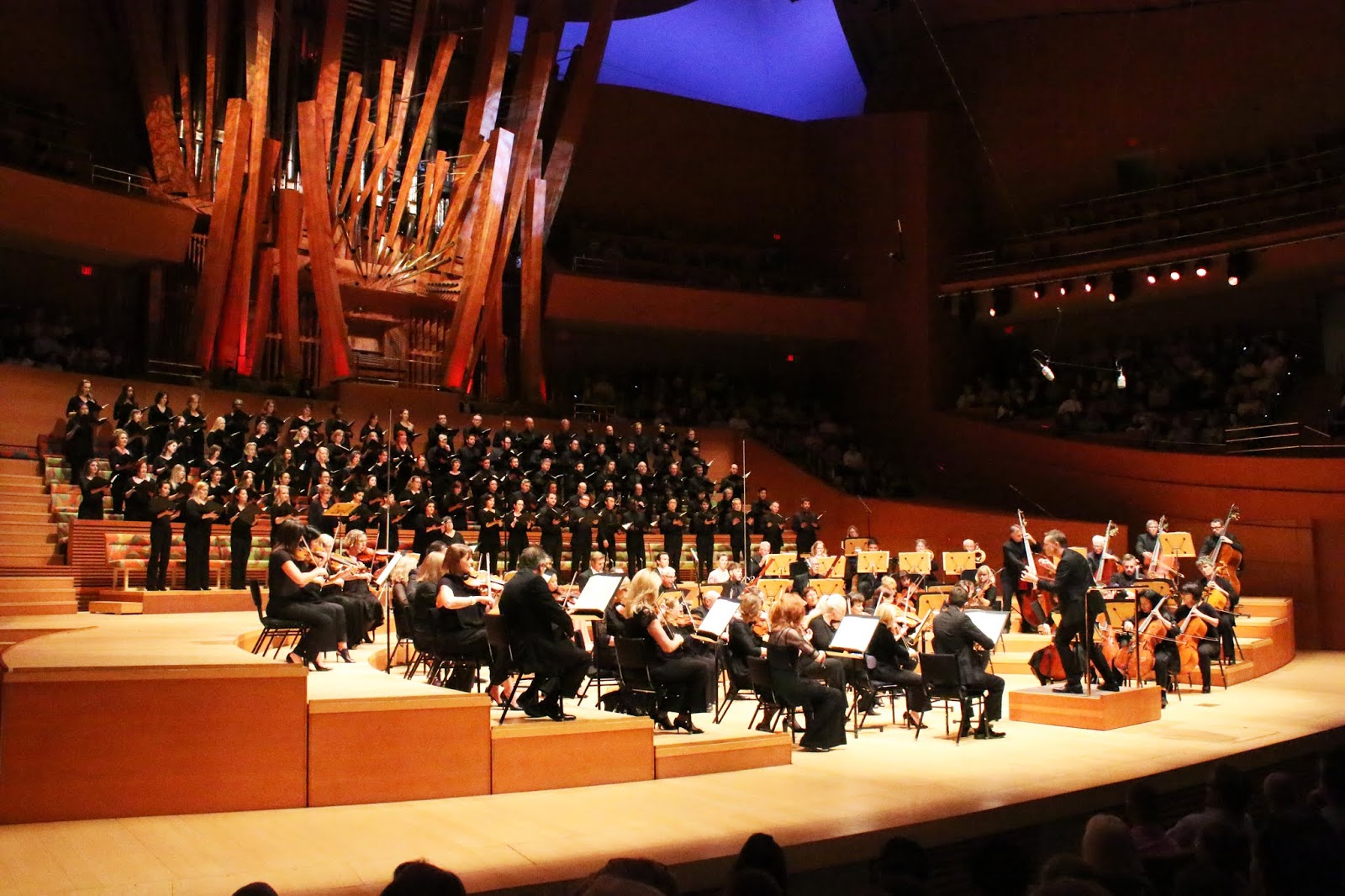
The Los Angeles Master Chorale with Grant Gershon conducting Photo: Patrick Brown 2018
With all of the hoopla surrounding the opening of the Los Angeles Philharmonic’s 100th Season this past week, it might have been easy to miss word of the first show of the Los Angeles Master Chorale’s 2018/2019 season last Sunday. That would be a shame because there was much to love about these sold-out performances, which came at the front end of the LAMC’s world tour of Orlando Di Lasso’s Lagrime di San Pietro in a Peter Sellars staging currently visiting locations in Australia and Latin America. Even though these are very exciting times for the LAMC, the season opener was entirely different material featuring a new version of Shawn Kirchner’s 2015 Songs of Ascent and Mozart’s incomplete Requiem in D Minor. The Kirchner piece (not to be confused with Meredith Monk’s 2011 Songs of Ascension) draws on text from Psalms 120-134. Kirchner felt the original version wasn’t quite as fleshed out as he’d hoped, and the version here was expanded. It is a pretty work with an admirable theme of love overcoming conflict. However, it can also seem superficial at times, missing a certain weight or drama. Soloists Adbiel Gonzalez and Robert Norman were well-suited to their parts though the evening’s drama would need to wait until after the intermission.
And that drama did arrive with a wonderful performance of Mozart’s Requiem. The LAMC brought in an excellent team of soloists including J’Nai Bridges, Liv Redpath, David Portillo and Rod Gilfry. Gershon dug in with his vocalists and orchestra, feeling comfortable and well-rehearsed with the material. The easy certainty gave the proceedings a real sense of awe of the unknown in the face of the biggest human certainty – death. By turns dark and weighty and at others soaring and light, it was a top-tier Mozart performance. The crowd responded with great enthusiasm, which must have been a heartening send off for the group on their tour.
A scene for Don Carlo Photo: Cory Weaver/Los Angeles Opera 2018 Los Angeles Opera opened it’s 2018/2019 season last weekend with a return of Verdi’s Don Carlo. It had a dream cast, even though that dream may have been from 15 years ago. In some ways that might be appropriate in that the production itself from 2006 is being revived here for the first time. And a dozen years later, the two best things about the show were still intact – the superb conducting from LA Opera music director James Conlon and the unparalleled bass Feruccio Furlanetto as the besieged-on-all-sides King Philip II of Spain. The cast also featured Ramon Vargas in the title role, Anna Smirnova as Princess Eboli and Ana Maria Martinez as Elisabeth de Valois. All of them had their moments, though the chemistry between the cast often felt lukewarm on this opening night. It wasn’t until the series of star solo moments in the final two acts that the show really started to take off when each of these excellent singers was given their chance to shine on their own unencumbered. Another big hero of the evening was Chorus Master Grant Gershon, who continues to deliver a vastly improved chorus that repeatedly stepped up to the task at hand with flair on opening night.
And then there was Placido Domingo. The company’s General Director, biggest advocate and patron, and an unquestionable living legend. This production follows the model of the tenor’s performances of latter years by casting him in the premiere baritone role, in this case Rodrigo, and letting him do what he does best — provide a stirring performance with his voice — essentially what the art of opera is at its very core. That has not changed, and he is amazing to watch. He is certainly reason enough to see the show. But it is not a performance that quells all of the questions and criticisms of his output in these recent years of his career. His is not the ideal voice for these baritone roles. And when he appears as Carlos’ young, idealistic brother-in-spirit, the age difference between him and the rest of the cast is readily apparent. It’s a great wig and costume to be sure, but there is something missing chemistry-wise. And while Domingo’s vocalism goes a long was to correct that disparity, it doesn’t quite overcome it.
The production, originally from Ian Judge, hasn’t aged entirely well and now looks somewhat thin and undercooked compared to 2006. The production was telecast to remote locations for outdoor audiences in Los Angeles County this year, and that camerawork may have well livened up some of the more bland moments in the house. It was certainly a nice gesture to the community from the company and one that many other companies around the world have done in recent years. The good news is that there are still 5 performances left and likely some of that opening night stiffness that plagued the first half of the evening will relax into a great show.
A scene for Pagliacci Photo: Cory Weaver/San Francisco Opera 2018 San Francisco Opera has opened its 2018/2019 season with two productions that raise questions about the links between various operas and how those links can inform individual productions or performances. The season opened with two of the most closely linked operas in the standard repertoire, Mascagni’s Cavalleria Rusticana and Leoncavallo’s Pagliacci. These two staples of the verismo tradition have commonly been presented together due to the many stylistic and content similarities between them. But the performance precedent that binds the two works wasn’t quite enough of a connection for this 2012 production designed and created by tenor José Cura who bound the two even more tightly together by attempting to make them two acts within a single narrative. The setting is moved to La Boca, an Italian-immigrant neighborhood in 1920s Buenos Aires with characters from both opera appearing onstage throughout the evening. In fact both Mascagni and Leoncavallo themselves appear to watch the action they have written transpire onstage, and the prologue to Pagliacci is performed by the character Leoncavallo himself. Mamma Lucia also becomes a central figure commiserating with Marco Berti’s Canio in Pagliacci 6 months following the death of her son in the evenings first half. She also steals the last line of Pagliacci right out of Canio’s mouth. It wasn’t clear to me how successful this narrative approach was and it was just as puzzling at times as it was dramatically engaging.
However, much about this performance seen on the 16th of September soared. Daniele Callegari elicited a well-paced and passionate performance from all the musical artists. The star of the afternoon was easily Dimitri Platanias, the Greek baritone who appeared as both Alfio and Tonio. He easily commanded the stage at all times and went further toward providing glue between the elements of both operas than any of the symbolic machinations of the set design. Jill Grove was a great Mamma Lucia and showed off her excellent acting chops in Pagliacci where she was often present with nothing to sing. Tenor Roberto Aronica goes back many years with this company and his Turiddu was a fine addition to the many roles he has excelled in here.
The closing scene of Roberto Devereux with Sondra Radvanovsky Photo: Cory Weaver/San Francisco Opera 2018
The other opera opening this San Francisco Opera season was Donizetti’s Roberto Devereux. The opera is one of three that Donizetti wrote about England’s Tudor royal family. (The others being Anna Bolena and Maria Stuarda) So there are natural companions to this bel canto masterpiece, and many opera companies have presented them in series with appropriate vocal artists to fill thee very challenging leading roles. In this instance, SFO imported a recent production of Devereux from the Dallas Opera by Stephen Lawless. Lawless designed a circular stage mimicking an Elizabethan theater to compliment the time frame of the depicted events of the opera. In Dallas this set was used for all three of Donizetti’s Tudor operas over different seasons, but on this outing in San Francisco it stood alone, mostly as a vehicle for star soprano Sondra Radvanovsky. Given that the production was taken somewhat out of context of the trio it was originally intended for, elements of the staging that was suggestive of linkages between the works could seem confusing or out of place here including large glass display cases containing bodies for the assassinated victims of Donizetti’s other Tudor operas.
Musically, this production seen on Friday September 14th wasn’t as solid as the verismo offerings. Radvanovsky is rightly a huge star. Her large, colorful tone has been the centerpiece of Verdi and Puccini performances all over the world for well over a decade. She has taken on these Tudor roles in the last several years including at the Metropolitan Opera in New York where she performed all three in a single season. And while she makes the role her own, the bel canto works are not as natural a fit for her as many of her other signature roles. She could turn overly steely at times and her Elizabeth was as likely to seem petty as regal. She was well matched by a world class cast including Russell Thomas in the title role and Jamie Barton as Sara who both gave warm, well-developed performances. Riccardo Frizza conducted the performance, which could have been a bit crisper. Still this is a prime change to see a A-level cast in a rarely performed opera.
Andrea Silvestrelli as Hagen, Daniel Brenna as Siegfried, and members of the San Francisco Opera Chorus Photo: Cory Weaver/San Francisco Opera 2018
On Sunday, the San Francisco Opera closed the second of three performances of Wagner’s Der Ring des Nibelungen with a thoroughly enjoyable performance of Götterdammerung. It’s a satisfying performance to be sure if not necessarily a great one. Zambello’s pastiche of themes pulls into the arguable “feminist” phase of the cycle with a focus on the women in the cast – Rheinmaidens, Gutrune and Bünnhilde - gathering together to do what is right. They bring an end to the morally bankrupt order of the gods by returning the gold to its rightful place and offing the likes of Hagen who is suffocated with a bag instead of drowning in the Rhein. All of this is certainly fair game artistically and feminist themes, like the elements of class struggle and the role of environmentalism that permeate Zambello’s production, are interesting, worthwhile interpretative ideas. What’s missing, though, and really what keeps this production from being great in the end, is how painfully spelled out it all is for the audience. Zambello’s direction is often broad and so on-the-nose that there is little room for bewilderment or mystery. Take Act II in this case where the Gibichung men en masse physically assault their wives when the women show support and concern for the wronged and defiant Brünnhilde. It does help set up the role these same women will play in the finale, but it’s also rather labored in its efforts to get the point across. A great production, one that bears viewing over and over, is one that pulls you in but never entirely reveals itself to you. One that always leaves you looking and wondering. One that yields something new on each viewing.
And just as the production fully reveals itself in these final five hours, the musical performance does as well. Donald Runnicles has conducted beautiful performances all week without a doubt. Performances of the Ring have been his hallmark with this company throughout his long association with them. But Sunday, and all of the Ring performances this week, also revealed some changes. His conducting was far less urgent than previously and often more relaxed and methodical. It certainly was an approach that made room for the vocalists on stage, and Irene Theorin continued to deliver real excitement on stage. At times her sound would drift away in the middle range getting lost in the orchestra, but there was never any doubt who was at the center of it all. Daniel Brenna continued to be an energetic and clear Siegfried, and Andrea Silvestrelli was an able Hagen. Perhaps even more important than ideas in an opera production, though, is chemistry. And if the measure is how well all of these artists spurred each other on in a performance is any gauge of success, San Francisco has remounted a Ring cycle that any company should envy.
Iréne Theorin as Brünnhilde and Daniel Brenna as Siegfried Photo: Cory Weaver/San Francisco Opera 2018
It’s an unusual distinction, but after its third outing in a decade Francesca Zambello’s staging of Wagner’s Der Ring des Nibelungen remains consistent - Siegfried is the strongest of the four operas in her vision of the cycle. I was reminded of this on Friday (my third time seeing this particular staging), where I reflected how sad it is that, of all the Ring operas, Siegfried is the most likely to be skipped or overlooked by a general audience. It easily has some of the most beautiful music in the entire work and Zambello’s environmentalist slant fits most nicely here in the deep dark woods. The gods' corruption under Wotan is paralleled by the encroaching forces of a polluted, mechanical world. Zambello's most striking images tie into the coming revolution and rise of the natural world championed by the hero Siegfried and Brunnhilde. In Act II Fafner, now a dragon, is less a prehistoric lizard and more a faceless tank, whom Siegfried destroys by removing crucial circuitry. It’s also oddly perhaps the best take on the dragon I’ve seen. It’s both threatening and a little scary which is saying quite a lot, given the difficulty in staging some of Wagner’s most fairy tale-inspired moments.
American tenor, Daniel Brenna again takes on the role of Siegfried as he did two years ago in Washington, DC. His youthful energy is a natural fit for this most challenging of operatic parts. Siegfried is often criticized as bland and dopey, but Brenna fills him with enough youthful fervor that those criticisms seems less applicable here. Greer Grimsley had a particularly good night as Wotan and David Congelosi’s Mime continues to be a centerpiece to the whole evening. Iréne Theorin’s Brünnhilde awakens after nearly two decades asleep with a questionable blond wig that proves an unfortunate distraction to her remarkably satisfying performance. Apparently one’s hair grows while they are asleep, even if their nails do not. Lucky for this Brünnhilde, the Veronica Lake look still seals the deal with Siegfried, and the love duet that closes Act III is as enthralling as ever.
Brandon Jovanovich as Siegmund and Karita Mattila as Sieglinde Photo: Cory Weaver/San Francisco Opera 2018
Opera often seems like a miracle. It’s really just an incredible feat of the hard work of hundreds of artists from different disciplines all working together toward a common goal. But sometimes it still takes some amazing acts of divine intervention for everything to happen when it does. And much was miraculous about Die Walküre, the second night of Wagner’s Das Ring des Nibelungen as seen in the San Francisco Opera’s current production now on stage. Perhaps the biggest miracle was the substitution of the originally scheduled soprano Evelyn Herlitzius who cancelled just weeks before the opening with the much lauded Iréne Theorin in the central role of Brünnhilde. Finding an artist of Theorin’s stature at the last minute for perhaps the most difficult role in all of opera is one thing; getting her here though was another entirely. Apparently when the current morally bankrupt US administration isn’t busy keeping the county safe from brown-skinned toddlers, opera singers are a close second on their watch list. I’m told every favor imaginable was called in and strings enough for a dozen harps were pulled to get Theorin's visa approved in time under the sad conditions that are increasingly the case in the decline of this once-great nation.
Luckily she did make it and whatever strings were pulled, they were well worth pulling. Theorin was a blazing presence Tuesday, vocally and theatrically. She bounds into Act II with limitless energy clearly pushing all involved from the orchestra and conductor, Donald Runnicles to her Wotan, Greer Grimsley to dig deep. She was thrilling to watch throughout and her fierce, confident tone bore an ease enviable for any vocalist at these echelons of Wagnerian performance. The next miracle was how expertly matched she was with a superb cast across the board. Karita Mattila, an artist with few equals on today’s stage, brought her Sieglinde to town opposite Brandon Jovanovich who reprised his Siegmund from the Ring’s last outing here. Mattila manages frailty, passion, and a growing conviction in her performance that commands everything around her. Jovanovich is noble and warm-toned throughout. Jamie Barton, as Fricka, takes one of the thorniest challenges in all of the Ring's demands. In Act II she manages a mesmerizing, searing turn in straightening out her wayward husband without a decent into caricature.
These kinds of performances can often go far in making up for a multitude of sins when it comes to a production’s overall quality. But Zambello’s diffuse shifting vision holds steady on this outing. There continues to be enough visual flash and atmosphere to keep things interesting and her parachuting Valkyries excite the crowd as much as they have at any time during the life of this production. The emotional range feels far less telegraphed than it often did during the productions initial run as a confidence and certainty have taken its place. Given that Zambello’s Siegfried has long been a calling care of her Ring production, there is a lot to look forward to this week.
Falk Struckmann as Alberich as Greer Grimsley as Wotan Photo: Cory Weaver/San Francisco Opera 2018Richard Wagner’s Der Ring des Nibelungen has returned to San Francisco this June. It’s a welcome return with an excellent cast that I got the chance to catch this week during the second cycle which started last night with Das Rheingold. Wagner is always timely of course so there’s never really a wrong time to reconsider any of his work. And as director Francesca Zambello argues with all the negative going on in the world right now this cornerstone experience of Western art is particularly inviting with its themes of rebirth and redemption. For those of you just now joining the story, Zambello’s Ring was originally a co-production between Washington National Opera and San Francisco Opera and was dubbed the “American Ring” in its early development. Of course the original roll out hit a sizable bump in the road following the economic crash of 2008, which nearly finished off WNO, leaving SFO to complete the developmental process on its own halfway through the four premieres. When the completed full version of the work hit the stage in 2011, much had changed and the original American theme had been abandoned half-way through for a more environmentally conscious and concerned one. Still somewhat of a thematic hybrid, the show was a success and eventually arrived in Washington in 2016 to positive reviews and eventually Zambello herself took the artistic helm of that company.
Now, two years later, Zambello’s Ring returns of San Francisco with some tweaking for another run. Das Rheingold more than any other of the operas in this production, still clings to that original “American” conceit. The gods are still dressed like robber barons of the late 19th and early 20th century in contrast to the giants who are clearly denim clad steelworkers invoking a sort of industrial age class warfare. It’s not a radically new concept of course and Zambello does try to even out the thematic issues by crafting some new water and fire video imagery this time around for Rheingold to display during the overture. There are still some issues, however, with overly broad acting and busy stage business between the gods that makes too little of their dignified and regal nature. Still this creakiness doesn’t overwhelm the many great things this Rheingold has going for it and the overall effect still works.
Perhaps the biggest of these is the return of Stefan Margita as Loge. Margita has made this role his all over the world and he has again returned to San Francisco for it. He has mastered the perfect combination of menace, craftiness, and humor to make Loge the central character in this ensemble. Perhaps the other most welcomed return was that of former SFO Music director, Donald Runnicles who conducted the SFO orchestra with real warmth and palpable excitement. Meanwhile familiar faces and voices abounded in the cast with Andrea Silvestrelli, David Cangelosi, Ronnita Miller, Raymond Aceto, Stacey Tappan, Lauren McNeese and Renee Tatum all returning from eight years ago.
Of the relative newcomers, the Alberich here, Falk Struckmann was a little slow hitting his vocal stride out of the gate, but by the time he and the others arrived in Nibelheim, he was creepy and powerfully on target. Greer Grimsley, as Wotan, and Jamie Barton, as Fricka, have also joined the cast and did an excellent job of laying the necessary groundwork for the heavy lifting awaiting them in Die Walkure. In the end it was a promising kick off to a reassuringly good production. And isn’t it nice to have something to count on these days?
The Los Angeles Master Chorale performs Lagrime di San Pietro Photo: Patrick Brown 2018
The Los Angeles Master Chorale is having a moment. They’ve had many before but this past weekend was clearly another. It was the Chorale’s annual Gala and there was feeling of anticipation in the air. Not only over the encore performance of Orlando di Lasso’s Lagrime di San Pietro, which garnered critically ecstatic reviews for the ensemble in 2016, but also because of the coming world tour they will head out for next fall and spring. The LAMC is no stranger to touring, but it has often been in conjunction with other groups like the Los Angeles Philharmonic. But this tour, which will take them to London, Paris, and other points around the globe is a solo, a cappella endeavor that will feature the performance of Lagrime.
And from the looks of things this past weekend, the Chorale is in for even more accolades. Lagrime, with a staging by Peter Sellars and conducted by Artistic Director Grant Gershon, is even stronger and more natural than before. The 75-minute work consists of 20 madrigals and one Latin motet performed in this instance by 21 choristers. The text concerns the stages of grief experienced by St. Peter after his denial of Jesus and the work has an intriguing shifting perspective over the course of its sections. Sellars casts the work as one not only about regret but of forgiveness, with the choristers constantly in motion having memorized the text. It’s vintage Sellars mining the most human aspects of the work by joining them to basic, clearly expressed emotional states and interactions of the performers. The sacred becomes fleshy and earthbound in bodies pleading, reaching and touching. There is an immediacy to it that draws the audience in and never quite lets go. It is undoubtedly a huge challenge for the Chorale who are often operating well outside their comfort zone. The choristers at times sing in prone positions or supine on the floor. All of it looks very natural. But this time around compared to 2016, the piece seemed even more fluid and intense. But it is perhaps the final motet that packs the strongest punch. In this last stanza the voice of the text shifts to that of Jesus himself commenting on Peter’s betrayal and the sinfulness of the world. It’s an angry and accusatory Jesus, but Sellars has placed these words in the voices of two rows of vocalists slowly approaching each other from opposite sides of the stage only to meet in the warmest of embraces at the end. It’s a profound and stirring image of love in the face of betrayal and conflict. Simply put, the LAMC has a new calling card. So watch out world; it’s coming your way.
The Los Angeles Master Chorale performs Israel in Egypt Photo: Patrick Brown 2018
Like many music organizations, the Los Angeles Master Chorale has increasingly ventured into artistic collaborations with artists in other genre and media in recent years looking for new and compelling way to interact with their audiences. Last year the group presented a staged version of Orlando di Lasso’s Lagrime di San Pietro under the direction of Peter Sellars that received rave reviews and is about to become the ensemble’s calling card around the world. They’ll be taking it on the road all on their own around the country and around the world in their first ever international solo tour. Needless to say, these are exciting times for the LAMC and Kiki and David Gindler Artistic Director Grant Gershon, who also just announced an exciting 2018/2019 season filled with new work to rival their colleagues at the Los Angeles Philharmonic.
However before those events, the Chorale this weekend presented another major collaboration. This time out it was the complete version of Handel’s Israel in Egypt, which was accompanied by a large scale real-time painting and video installation from Kevork Mourad. The pairing couldn’t have been more appropriate as Mourad has often returned to themes of immigration, displacement, and refugees in his work in other contexts, which he did again Sunday night. Handel’s oratorio is similar to his Messiah in that it is primarily written for full chorus with few solo interjections. There are no individual characters per se and much of the dramatic action is described as opposed to acted out. And though the material is somber, the interaction between these artists produced a work of astounding beauty much of the time. Mourad’s process is a fascinating combination of pre-existing animated elements combined with projections of real-time painting he does with ink on paper. The two different image feeds are then mixed and projected together in different combinations in the moment not unlike a DJ might do with audio tracks. The largely monochromatic images clearly contained figurative elements suggesting refugees wandering through evocative unspecified cityscapes that recalled Egypt. But at the same time, ink unfurled on the page like plumes of smoke.
The net effect was profound and the chorus sounded assured. Admittedly the tone was also unrelenting and methodical at times giving the proceedings an unmistakably dire tone that, while appropriate, ran the risk of monotony as the performance went on. Still the quality of the musicianship overcame any of these concerns and the LAMC delivered another winning evening of incredibly moving and reflective music. This intensity is going to serve them well very soon on the road.
Hye Jung Lee in Girls of the Golden West Photo: Cory Weaver 2017
John Adams’ latest opera, Girls of the Golden West with a libretto by his frequent collaborator, stage director Peter Sellars, has arrived in San Francisco. Make no mistake, it is a major event. One so demanding it requires time to sink in so that it brought me back to the opera house twice for performances before I could even get a real sense of how to approach it. Now that’s not to say it’s a great opera. It’s certainly not Adams’ best. But that being said, it is not to be ignored. It is filled with enough musical and ideological ambition to launch a thousand other much lesser works. Girls of the Golden West will undoubtedly ruffle many feathers. It is non-narrative and has little in the way of character development. It is neither dramatically urgent nor meditative. It is an opera of ideas – big ideas that rarely make it into opera and for that alone it is commendable. Adams was present at the premiere and was awarded with the San Francisco Opera Medal by the company in recognition of his long association with the company. In his remarks from the stage he noted that he now sees how prescient this opera is in light of the current political climate. Girls of the Golden West is a look inside the poisoned and dark events that are inextricably bound up in Californian and American history but are often excised or removed for the sake of a noble narrative of young men invading and dominating the brutal land of the west.
The manner in which Adams and Sellars go about achieving these goals involves using original source materials including the diaries of one Louise Clappe, a writer and pioneer of 19th-century California who recorded much about life during the Gold Rush. Her characterization in the opera, as Dame Shirley, is one of the three “girls” of the title who also include a Chinese-born prostitute named Ah Sing and a saloon worker by the name of Josefa Segovia. None of the their stories actually intertwine in any meaningful way, although each contributes to the didactic flow of the piece. Against their recasting of commonly misconstrued history is a narrator figure, Clarence, who provides the whitewashed narrative about the golden coast and the hardy, spirited men who immigrated here searching for fortune. Of course, it was a much bloodier affair with lynchings and racial strife not uncommon in other parts of the country at that time. The three women, and some of the men in their lives including the former slave Ned Peters, quickly run up against this blunt reality even in the newfound West. Much of this strife plays out in the dreamlike second Act which harkens to the final act of Nixon in China where the reality of scenario seems to evaporate in service to the larger project in a manner that is both heady and alluring.
But what the show lacks in dramatic tension, it more than makes up for with some of the most stirring music Adams has written. He is plumbing American popular song idioms of the late 19th century with abandon here including direct references ot Stephen Foster and others. The several male courses can often bite and seduce at the same time. The closing aria sung by Julia Bullock regarding the beautiful sunset sky of California descending into night is completely gripping and awe inspiring. Both J’Nai Bridges as Josefa and Davione Tines and Ned Peters deliver arias touching on the searing nature of racial and social injustice that could be sung at any time in American history. Girls of the Golden West can grab you by the throat and will without hesitation. All of this is beautifully held together by conductor Grant Gershon who led the work premiere in his continued ascendency as an important figure in the opera world. This complicated, often shifting score was well served in his hands. So while this new opera may not make everyone happy, it would certainly make them think. And form Adams and Sellars, that is more than enough reason to celebrate.








Follow Along
Brian
Los Angeles
Follow me on Twitter